Showing posts with label London. Show all posts

Friday, February 24, 2017

Transforming a Warehouse Into a Well-Designed Home

Warehouse Home Magazine is a publication that explores the transformation of warehouses into homes. 

One of the design ideas I've been especially inspired by lately is the idea of transforming and living in non-traditional spaces, like old industrial warehouses. My interview with the CEO and Editor-in-Chief of Warehouse Home Magazine Sophie Bush was my introduction to this new way of living, and I must say that I am loving it! Warehouse Home Magazine features the best of historic and industrial warehouses in London and beyond, made new through architecture, interior design, and the imagination of their passionate owners. See the interview below.

Warehouse Home CEO and Editor-in-Chief, Sophie Bush.

Jacquin: Tell us about how your love of warehouse homes came to be. What do you find most charming about taking non-traditional spaces like warehouses and turning them into lovely decorated homes?

Sophie: I have always been passionate about architecture and interior design. When I moved to London, I was immediately drawn to its industrial conversions. These buildings represent a by-gone era of manufacturing that I find fascinating. And they have so much grit and character - they offer a very different way of living for more conventional and contemporary flats. Authentic features like exposed brickwork and concrete are incredible backdrops for adventurous homeowners and interior designers - normal interior decor rules don't apply here, you can really get creative! At the same time, steel columns and more unusual proportions, including high ceilings, can represent challenges when it comes to establishing different living areas in an industrial conversion. But no two warehouse homes are the same - and that's what I think really appeals to their residents and to anyone channelling that industrial look.

CEO of Warehouse Home Magazine, Sophie Bush, photographed in front of one of London's historic warehouse homes, revived with contemporary style. 

Transformed warehouse home in London.

Jacquin: How was your experience transforming and decorating your own warehouse home, Sophie? What challenges did you face? What was most rewarding?

Sophie: I've drawn a great deal of inspiration from the heritage of the building - it's a grade II listed former mill on the banks of the River Thames. Much of my furniture has been sourced via London-based salvage experts like LASSCO, The Old Cinema and Retrouvius, but I've had quite a bit of success on eBay too - including a beautiful old school desk, used as a side table. I love hard-wearing, heavy-duty pieces and classic industrial designs that started their lives on the factory floor. But I've combined these with contemporary designs from high-street brands like Made.com and H&M Home

The ceilings are relatively low and combined with exposed brickwork that could make spaces like the living room look gloomy, so I've incorporated bold splashes of red. Large-scale typographic prints create a contemporary effect and modern metal cabinets on castors reference the industrial features. Right now so much of my time is spent on Warehouse Home magazine, that I am still transforming my own home. It's a careful and considered process where the spaces are gradually evolving. And I actually really like that - there's a sense that every item has 'found its place' over time.

Peek inside the warehouse home of Warehouse Home founder, Sophie Bush.

Jacquin: What details should home buyers consider when deciding whether to pursue a warehouse home or other non-traditional space as a home? What advice would you give to people in the process of transforming a warehouse into a well-decorated home?

Sophie: The debut Warehouse Home book provides so much inspiration for these scenarios. It showcases the most incredible homes all over the world, from San Francisco to Sydney, London to Hong Kong, and numerous locations in between. There are family homes in former factories and foundries, bachelor pads in old printworks and cement works and much more besides! The homes are collected together in chapters themed around typical industrial architectural features - like brickwork, beams, columns, warehouse windows - and showcases the many ways in which these heritage elements can be preserved, celebrated and adapted for modern living. These properties vary enormously so there is no one-size-fits-all solution for a conversion home - I would simply suggest really embracing the industrial characteristics and enjoying the process of finding both vintage and contemporary furnishings to complement them.

The debut BOOK Warehouse Home will be available for purchase April 2017.

Inside of a historic Spratt's factory renovated unit featured in Warehouse Home Magazine.

Jacquin: What are your all time favorite warehouse homes that you've featured in your magazine, Warehouse Home?

Sophie: In Warehouse Home Issue Four, photographer Debbie Bragg contributed photographs of her own home, together with the homes of three of her neighbours, all in London's iconic Spratt's Works - a former dog food factory. When the building's conversion was completed in 1989, the units were sold as empty shells - so every home is entirely unique, as Debbie's photographs demonstrate. One of the apartments depicted belongs to the incredible denim artist Ian Berry - he lives entirely surrounded by scraps of the fabric in every conceivable shade of blue, it's a truly unique live-work environment.

We also featured the home of chef and entrepreneur Patrick Drake, co-founder of HelloFresh, in Warehouse Home Issue Five. Situated in London's fashionable Shoreditch, it's light and airy with white-painted exposed brickwork and a minimalist scheme.

London's historic Spratt's factory revived into several individual homes. 

Warehouse home of HelloFresh founder, Patrick Drake.

Inside of a historic Spratt's factory renovated unit featured in Warehouse Home Magazine.

Jacquin: What can readers expect from Warehouse Home Magazine in 2017? What are you most looking forward to for your business this year?

Sophie: You can expect to see more furniture and lighting added to our online shop over the coming months. And the debut Warehouse Home book published by Thames & Hudson will be out in April - there will be various exciting events to coincide with its launch. We've also launched an online subscription service, which is proving incredibly popular and enables customers to order any of our back issues, as well as pre-order Warehouse Home Issue Six (which will be out in June). 

We have ambitious plans to grow the Warehouse Home brand even further over the coming months. In addition to raising angel investment, we've received a number of enquiries about crowdfunding. So, on 13th March we'll be launching a crowdfunding campaign with Seedrs - a platform which enables anyone to invest in businesses they believe in from as little as £10. It's easy to register and we would love as many people as possible to watch our video and hear what we have planned. 

If the idea of transforming a spacious warehouse property into a contemporary home peaks your interest, be sure to subscribe to Warehouse Home Magazine for more industrial-style inspiration. 

Monday, January 23, 2017

Designer Spotlight: Ponyo Porco of Taiwan


Ponyo Porco, based in Taiwan, is a print & textile design company focusing on fine art, fashion, and graphic design with the intention of their painterly prints being used across the spectrum. Ponyo Porco's hand-painted print designs lend themselves to uses from home decor to fashion and more and has landed the brand a coveted spot in New York Fashion Week this year. Take a look at our recent interview with Crystal Lupa and Larry Chen, the creative design duo behind Ponyo Porco.

Ponyo Porco at 2016 New York Fashion Week.

I saw your runway show at NYFW this past fall, is this the beginning of Ponyo Porco being a part of the international fashion industry?

Lupa: It was really a good start for us to share our concept and creations around the world as we are a very new team. It’s not easy but we are working hard on developing our brand to be more connected with the international creative industry.


How did you become interested in working for the fashion industry?

Larry: Ironically, we started our careers not that interested in the fashion industry but we both liked to create and design with prints. And since Lupa graduated with a focus on fashion design women’s wear, we combined our specialties to create a brand that is not just about fashion, but more so a print lifestyle brand.


Artist Crystal Lupa, one of the creative forces behind Ponyo Porco.

I noticed that each collection has an excerpt or poem that goes with it, what came first as inspiration – the writing or the collection?

Lupa: You're right. Each print has it’s own poem and original artwork. The poems are always written once the artwork is complete and serves as a description. 

Original artwork for Ponyo Porco prints.

Original artwork for Ponyo Porco prints.

Since your designs have a fairytale aspect (especially with the use of writing) are their any childhood stories, folktales, and stories etc. that inspire the design process?

Lupa: My painting style is definitely inspired from childhood stories and folk art. I often create characters with self-invented logics about the world, and love to express a glimpse of cold, dark charm in the style of naïve amusement. I’m especially attracted to seemingly inanimate organic forms. While trying to endow them with personified characteristics, I also like to demonstrate an event or scene narratively.

Original artwork for Ponyo Porco prints.

What is each of your favorite pieces, or favorite collections you have worked on?

Lupa: My favorite pieces are the prints of WITCH&CROWS coat and the POOL pleated dress.

Larry: I like the printed coats in all prints!


Do either of you have a fashion icon that you find inspirational?

Lupa: Frida Kahlo

Larry: Yves Saint Laurent


Since, Ponyo Porco is based in Taiwan, how does that influence your work?

Lupa: Although we founded the brand in Taipei, most of the education in art and working experience is in London. So I can say that there is a mixture of cultures in the creation. Taiwan is a beautiful island filled with oriental visual inspiration as well as various foreign influences, both of which greatly impact our work.


How does Ponyo Porco want their buyers to feel when they wear your collection?

Larry & Lupa: Unique, bold, delicate, and playful!

How much does the type of material and fabric influence each piece? Is there a specific way in which you select them?

Lupa: For Ponyo Porco the textures and characteristics are very important. Before we confirm the fabric for each piece, we digitally print on more than 15 kinds of materials for samples. We use 100% polyester fabric for pieces that need to be pleated, because the cotton won’t stay in pleats after a few washes. And for the coats and bomber jackets, we use 100% cotton with a satin finish to bring a subtle glow for more formal occasions.


What do you hope to see Ponyo Porco to become in the future?

Larry: So far we have developed our print ideas into a diversity of products such as clothing, accessories, paper products, and packaging. As we move forward we look to cooperate with brands, manufacturers, and studios from various fields to develop creative products in even more forms. There will also be a great 2017 calendar and a menswear capsule collection. Overall, we hope to become a strong design team and feast for the eyes of the print lovers around the world.

By Jamie Lee, Interiors by Jacquin intern

Monday, November 21, 2016

Colorful Hand-Woven Furniture from 'A Rum Fellow' Design Studio


'A Rum Fellow' design studio project for a Soho Hotel, featuring their textiles on a custom headboard.

If you've been reading this blog for a while then you know that I love woven and embroidered accents, whether that's an amazing embroidered top or a truly unique piece of upholstered furniture showcasing a stunning woven design. A Rum Fellow design studio is crafting cutting edge woven and embroidered textile designs for furniture and home decor accessories, bringing contemporary energy to this traditional craft. I am loving their unique approach to upholstered furniture! Hand-weaving and embroidery is the key to making each piece of A Rum Fellow furniture feel truly special. 

Whaley Chair, Copii brocade and linen 

Kurt Olsen Lounge Chair #31

One of the best things about decorating with embroidered and hand-woven decor is that you can't go wrong whether you're selecting a bright and bold color palette or a more neutral palette. The textures in embroidered and woven designs pop regardless of the colors used, making even the most neutral embroidered designs shine. Check out this stunning neutral living room featuring a sofa upholstered in A Rum Fellow hand-woven textiles. 

A Rum Fellow design studio project for a Country Home. 

Brocade and ikat Kai Kristiansen Chairs

A Rum Fellow design studio project for Crosby Street Hotel.

I also can't get enough of A Rum Fellow's unique headboard designs, each featuring a different textile from their studio. However, my absolute favorite piece from A Rum Fellow is this amazing multicolored armchair designed for a home in Provence. A Rum Fellow is quickly becoming one of my (many) new favorite brands!

A Rum Fellow design studio project for a home in Provence.

A Rum Fellow is a London-based design studio founded by Caroline Lindsell and Dylan O'Shea focusing on hand-woven textile designs. This great team crafts textile and furniture designs that effortlessly blends the contemporary with heritage design, all from a unique global perspective.

Sunday, October 18, 2015

Artist Spotlight: Printmaker Alison Headley


Name: Alison Headley
Artform: Printmaking
Location: UK

Jacquin: How did you connect with printmaking as your preferred medium?

Alison: I have always enjoyed looking at printmaking and buying etchings, screenprints and Linoprints.  The textures and smooth luminous quality that you find in this kind of artwork fascinated me.  And although I've always loved painting and drawing I wanted to try something new art wise so when I saw a course in printmaking four years ago I decided to sign up for it. Even though I tried all the other techniques in printmaking (etching, etc.), it was Lino that instantly clicked with me.


Jacquin: What has been your favorite print to date? 

Alison: I can honestly say that each piece has a special place for me.  However, if I was to choose a significant image that I am drawn to more generally, it would be portraits.  I am especially fascinated by faces and love creating slightly oddball images that would possibly not happen in real life, like a bird standing on a girl's head or a beautiful butterfly landing on the tip of a lady's nose.  "Bird Perch" pictured above.


Jacquin: Tell us about your printmaking process.

Alison: I spend a lot of time on designing the image.  I usually draw an idea over and over until I feel I have the perfect balance for the Linoprint.  When I am finally satisfied I will trace my design onto the block and start cutting.  Depending on the size and design, this can take many many hours, not to mention blistered fingers and hands.


Jacquin: How do you select the subject of your works? 

Alison: My head is literally brimming with images I want to create on Lino.  It can get quite frustrating since I have to be selective, as not everything I think up will work well as a finished Linoprint.  Sometimes I've worked on a design for ages even traced it onto the Lino and then realised it just won't work well so have to scrap it.


Jacquin: What is inspiring you currently? 

Alison: I am inspired by so many things it's difficult to pin point just a few things.  Matisse is definitely the artist I'm drawn to when ever I need an extra shot of inspiration.  His ability to pare down an image to its essential lines and then turn it into something beautifully decorative is awe-inspiring!  I also love illustration and often think that some illustrators are in reality true artists!  Ana Juan and Olaf Hajek come to mind as artists/illustrators but honestly these are a tiny taste of what inspires me. 


Jacquin: What would the perfect day be like for you?

Alison: My Perfect day would have to be a sunny one (something which is rare in the UK).  I love love love spending time in London.  Definitely going to an exhibition, the Tate Modern is one of my favourites and the shop there is a treasure trove for art books.  Then enjoying Dim sum in Soho, a walk by the river and catching a play or going to the comedy store, finished by cocktails and dinner in a small French Bistro near Convent Garden.  Perfect!

To learn more about Alison Headley, visit her Artfinder page here. 

Tuesday, September 8, 2015

Sonya Winner Gives Rugs a Fine Art Appeal - Think Rothko-esque!

When I'm shopping for a rug I like to look for the most unique selections available, so when talented designer Sonya Winner of Sonya Rugs contacted me with her new collection of rugs, I jumped at the opportunity to share this designer with you.  I love the fine art feel of Sonya's rug designs.  They all tell a story and are highly creative.  


Sonya identifies color as both her inspiration and passion.  On the topic of her rugs and creativity, Sonya expresses just why color is her most transformative tool.

Coulour is key- it transforms an environment, changes mood, creates excitement, ambiance, interest and simply makes you happy. My passion for creating rugs stems from my aim to add vibrancy, warmth and positivity to a room.
My first rug was a revelation. I was overwhelmed at how it changed a room. Seeing my design woven for the first made me understand carefully chosen colours and their juxtaposition to one another speaks out to everyone- a universal language. This emotional response to colour and shape is something I want to use to evoke positive emotions in everyone who looks at my work.
 

Sonya describes her most recent collection (shown above, below) as Rothko-esque.  The vibrant colors and geometric shapes certainly do fit in with Rothko's painting style.


This tree trunk rug design is one of my favorites!  Its organic form brings a natural feel into the living room, along with a pleasant, saturated burst of color.


If you have an eye for truly special and unique decor, then I would definitely recommend a Sonya Winner rug.  They are really quite unique and perfect for the color lover!

For those of you in London, you can learn more about Sonya Rugs in person at Tent London taking place September 24-27.  Tent London is an international showcase of the best in contemporary design.  Sonya Rugs will be located in Hall T1, Stand F20.


Friday, July 17, 2015

Tips for Entertaining with Style (and with kids!)


London Interior Designer and Mom, Karolina Barnes has joined us today to share her lovely backyard BBQ along with her TOP 5 TIPS for entertaining in style... and with kids!  As a mom she's mastered juggling hosting preparations with looking after the children, all with ease and grace.  Not to mention, she's a designer too so her backyard BBQ is both stylish and infused with vibrant colors!  Karolina's tips aren't just for those of you with children though, but really for everyone.  Take a look at this family-friendly BBQ filled with loads of English-charm and plenty of color, hosted by Karolina Barnes of London. 


1. Approach your outdoor decor in a same way as your indoor. 

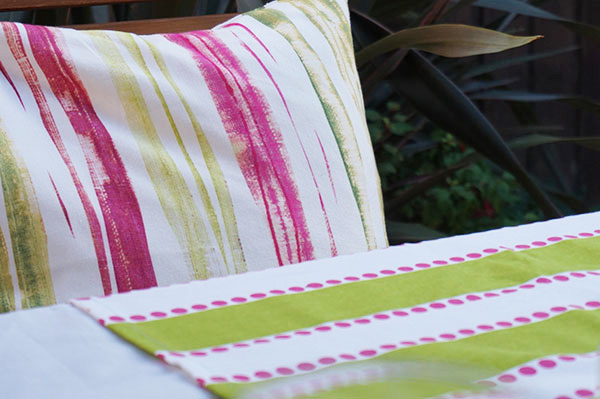
This means starting with a colour scheme of at least 4 core colours and working around them. In my case I started with the outdoor Ikea rug which added fuchsia pink and yellow. I also included green and blue décor as accents.  I managed to pull those colours together through the cushions on the seats and dinner plates.


2. Use textures and bold patterns.

I like using colours, textures and patterns to inject some personality into the space.  Bold colours in particular go really well against the greenery in your garden. 

Mixing patterns such as stripes, chevron and ikat (on my cushions) also makes the space more vibrant and individual.  I purposely didn’t want to create a matchy-matchy feel so I used different cushions on each chair but in the initial colour palette I started with.  


3. Use layers in table dressing.

If you have kids around, keep your table setting to its minimum. I like to start my table with a white table cloth since it provides a nice clean, elegant backdrop which is very easy to build upon.  Use flower pots and urns as a centre piece.  It will be a very nice touch.  Also, if your kids are old enough, get them involved in your preparations and special event.  They can help prepare the food, set the table, or even just pose for great family photos!

Think practically. In my case, instead of placemats, I used table runners which I layered over one another in crosses. To make my table more interesting, I used two different types of the table runner.  One was plain blue in glazed linen running through the centre of the table, and the other two were in bolder green cotton with fuchsia pink dots running vertically on either side of the table.  A lovely way to spice up your dining table! 


4. Invest in quality outdoor furniture.
I would recommend investing in the best quality outdoor furniture you can afford (see above).  Teak, eucalyptus and other hardwood can withstand harsh weather conditions throughout the year.  Teak in particular is very durable and hard-wearing.  Teak’s initial honey colour gradually changes to light silver grey, which has absolutely no effect on the longevity of the furniture.  If you prefer keeping it in the nice honey colour, use teak sealer to revive it once in a while.


5. Forget about perfection and just enjoy it!

Entertaining with kids is not always easy. Especially when you have to be the host, while manning the kitchen or BBQ grill and looking after the kids at the same time.  It can get very stressful. But my advice is, don’t try to make things perfect.  As long as the food is good and everybody is having a good time, you can give yourself a pat on the back.  

As a bonus, Karolina has shared her daughter's recipe for Strawberry Meringue Nest, which she served at her recent BBQ.  I've included her delicious yet simple recipe below. To learn more about Karolina or to check out her UK-based interior design services, please stop by her website here.  Happy Friday!

Strawberry meringue nest with cream  - super easy summer dessert!

Ingredients:
  • Ready prepared meringues (similar to these or make your own)
  • Fresh strawberries
  • Whipping cream
  • Superfine (caster) sugar - (You can simply blend regular sugar to make superfine sugar.)
  • Fresh mint leaves

First gently cook your cut strawberries with one table spoon of caster sugar and one spoon of water until you have a nice thick sauce with soft strawberries pieces running through it.

After it cools down, whip the cream with a third of the strawberry sauce so that it’s nice and light pink. Spoon the whipped cream on the meringue nest and decorate it with the remaining strawberry sauce and a mint leaf.  Voilà